
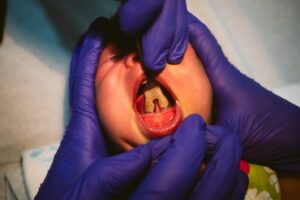
A frenectomy is a dental procedure that removes or releases a restrictive frenulum, the small fold of tissue that connects the lips, cheeks, or tongue to the surrounding tissues. In some children, a frenulum can restrict normal movement and contribute to difficulties with feeding, speech, oral hygiene, or dental development. But not every child with a prominent frenulum needs treatment. So, how can you tell if your child might benefit from a frenectomy? Here are 4 signs worth discussing with your child’s dentist.
1. Difficulty with Breastfeeding or Bottle-Feeding
In infants, a restrictive lingual frenulum, commonly called a tongue-tie, can interfere with the tongue’s ability to move properly. This may make it difficult for a baby to latch, maintain a latch, or effectively transfer milk.
Feeding difficulties can have many possible causes, so a frenectomy isn’t automatically the solution. If your baby consistently struggles with feeding, a pediatric dentist can evaluate whether a restrictive frenum may be contributing to the problem.
2. Limited Tongue Movement
A child with a restrictive tongue frenulum may have difficulty lifting or extending their tongue. You may notice that they cannot stick their tongue out very far or have trouble moving it from side to side.
Some children compensate well and experience no meaningful problems, while others may have functional limitations. A dental professional can assess tongue mobility and determine whether the frenulum is actually restricting function.
3. Speech Difficulties
As children develop speech, proper tongue movement becomes important for producing certain sounds. A restrictive frenulum may contribute to difficulty with some speech sounds in certain children.
However, a tongue-tie isn’t responsible for every speech problem. Speech development is complex, and speech-language evaluation may be appropriate. Your child’s dentist can work with other professionals like a speech therapist when determining whether a frenectomy could be beneficial.
4. Trouble Keeping Certain Areas Clean
A restrictive lip or tongue frenulum can sometimes make certain areas of the mouth more difficult to clean. For example, a prominent upper lip frenulum may make brushing around the gumline more challenging.
If plaque repeatedly accumulates around a particular area despite your child’s best efforts, mention it during their dental appointment. Your dentist can determine whether the frenulum’s position is contributing to the problem.
More on the Frenectomy Procedure
It’s understandable to be a bit nervous when your little one has to undergo a dental procedure involving laser therapy. To help put your mind at ease, consider the following facts:
- Laser frenectomies are a very common, safe procedure.
- A concentrated beam of light is used to sever the restrictive frenulum tissue.
- The procedure typically lasts between 10 and 15 minutes.
- The recovery period generally takes 1 to 2 weeks. It’s usually more manageable than many patients anticipate, and your dentist will give you aftercare instructions.
If you notice feeding difficulties, restricted tongue movement, speech concerns, cleaning challenges, or a persistent dental gap, schedule an evaluation with your child’s dentist. A thorough examination can help determine whether the frenum is affecting your child’s oral health and whether a frenectomy or another treatment option is appropriate.
About the Author
Dr. Payam Ishani is an experienced orthodontist based in Oklahoma City. He graduated from the University of California San Francisco School of Dentistry, followed by specialty training in orthodontics at the University of Nebraska Medical Center. If your little one is having trouble latching, speaking, or breathing, Dr. Ishani can examine them to determine if a frenectomy is necessary, and if it is, he and his team can provide fast, comfortable treatment with little to no bleeding and no stitches required in most cases. Visit our website for more information and scheduling or call (405) 254-5094.